Each November, in our newsletter, I take time to acknowledge the loss of my son Brian. He is the reason for all I do with the Brian Dagle Foundation and Brian’s Healing Hearts. November 12, 2011, is when he left this earth. Fourteen years later, this day is difficult for all of us who were touched by the love Brian had for his family, friends, and community.
This November 12th will mark fourteen years since he left us. Time is a funny thing when you are grieving. The days and weeks leading up to that day catapult you back in time feeling as though it was yesterday yet at the same time, there is pervasive feeling of foreverness since we last hugged.
The years have allowed for the pieces of my broken heart to be gently stitched together. But days leading up to that day sometimes feel as though the stitches begin to unravel, allowing my deep grief to rise to the surface and the reality of his loss is overwhelming. I know that all I can do is breath through the hard days and remind myself that this too will pass. That in time, the gratitude for my family, friends, and life shines a light into my dark. That in time, I’ll remember Brian’s beautiful smile and his indigo blue eyes smiling are down at me.
And I’ll smile too, thankful to be his mom.
With gratitude,
Ann Dagle
President
Brian Dagle Foundation
September was busy at the Brian Dagle Foundation. Just the last few days, we hosted Dr. Alan Wolfelt, a leading grief expert, for a public workshop on grief and a day-long workshop for over 150 therapists, social workers, clergy, nurses, and other caregivers and helpers on caring for people who are grieving. Events like this are only possible due to the financial support of people like you.
In the nine months of 2025 so far, your donations have allowed us to host:
- 995 people at grief support groups
- 591 participants in educational offerings
- 111 attendees for special events
- 75 coaches and parents on mental health and suicide awareness training
- 1000+ student athletes through our LAX2LIVE™ program
- 150+ doctors clinicians and staff at the Institute of Living grand rounds
We’ve had a an average of 16 inquiries each month with 98 new support group attendees this year, an increase from every year before. Doing this work is an honor and we couldn’t do it without you.
As we approach the end of the year, please consider supporting us with a donation on Giving Tuesday or as part of your planned end-of-year giving. That money is what provides our support group members with a comfortable, non-clinical setting to find hope and begin healing. It keeps our kitchen stocked with tea, coffee, and snacks to meet the physical needs of mourners. And it makes bringing opportunities like our workshops and training with Dr. Alan Wolfelt possible.
We are humbled and honored by every single one of you who comes through our doors as a support group member, a volunteer, or a workshop attendee. Your partnership in our mission is essential.
Ann Dagle
President
Brian Dagle Foundation
Charter Oak members can have their donations matched through November 20.
Fill out your matching gifts form to double your gift!
Since losing Brian to suicide in 2011, I’ve been advocating, promoting, and talking about suicide prevention anywhere and everywhere. Espeically during September which is National Suicide Awareness Month. I’ve educated myself and now I teach others on the warning signs and risk factors of mental health and suicide. At every training session I always say, “If I knew then what I know now, maybe my life would be different.”
I didn’t know the signs of someone struggling with their mental health or how to even talk about it? Brian didn’t have the language to share about his pain and I didn’t have the knowledge or understanding about how much he was struggling.
Here are a few things you can do this September to raise awareness for suicide:
- Pause and listen to someone when they tell you about their day.
- Learn about suicide prevention from AFSP.org or SERACCT.org.
- Ask for help when you need it.
- Call or text 988 if you or someone you know is having a mental health crisis.
- Participate in an Out of the Darkness Walk. Info and registration for our local walk at AFSP.org/Niantic.
988 is a tremendous resource. It is available any time of day or night, whether there is an immediate crisis or if you need to speak with someone who is trained to help you decide what to do next.
I want to personally invite you to three important events happening this month:
Navigating Suicide Grief Virtual Talk (Monday 9/15): I will share my story of loss, healing, and hope and offer light into the darkness for so many who are struggling with the tragedy of losing a loved one to suicide. THIS IS A VIRTUAL EVENT.
Understanding Your Grief (Monday 9/29):Led by grief expert Dr. Alan Wolfelt, this compassionate program will acknowledge that loss is an unavoidable part of human life, but it doesn’t have to prevent you from living well. The content of this evening program is based on Dr. Wolfelt’s book, First Aid for Broken Hearts.
The Art of “Companioning” the Bereaved (Tuesday 9/30): This workshop offers professional-level training accessible to anyone who companions the bereaved. Anchored in Dr. Alan Wolfelt’s “companioning” model of grief care, you’ll recognize how grief and mourning are normal and necessary experiences that are fundamentally a journey of the heart and soul. Registration ends 9/12. Sign up now at brianshealinghearts.org/Wolfelt
I hope you’ll join me this month in building awareness to prevent future suicides and honor the survivors left behind.
With love and hope,
Ann Dagle
President
Brian Dagle Foundation
Question: I see people promoting themselves as “grief experts.” When I attended your training, I think you mentioned that the true “expert” is the mourner. Can you expand on this?
Your memory is correct – I have always maintained that the true expert in grief is the mourner.
I do believe there is a real difference between studying a mysterious body of knowledge surrounding grief and committing yourself to helping people versus projecting oneself as a “grief expert.” The Companioning Model of Grief Care is anchored in “teach me” and “compassionate curiosity” about what the mourner is experiencing.
Compassionate curiosity for the companion is about being willing to enter into and learn about the mystery of grief while recognizing you do not and cannot fully understand someone else’s experience. Curiosity is bathed in an attitude of the “beginner’s mind and heart.”
This attitude is not ignorance but the capacity to see without assumptions, to take a fresh look each and every time you are privileged to walk with and learn from a mourner. It involves a clearing away of thoughts, beliefs, and ideas that might cloud your ability to see things as they are in pristine form.
As we all realize, children are naturally curious. As we grow up we are at risk for losing this state of heightened awareness and natural desire to learn from those around us. We may falsely assume we already know. In other words, our intellect takes over. Yet, being a companion to people in grief can reactivate our sense of miracle to bring a fresh, simple, unsophisticated view of things.
Paradoxically, you can only learn from the mourner by acknowledging you don’t know. It is out of your helplessness that you ultimately become helpful. You have to be willing to disconnect from believing you have superior expertise of another human being’s emotional-spiritual journey of grief.
Through no fault of your own, your training as a caregiver may make it difficult to admit you don’t know and don’t have answers. You may instinctively be frightened to be present to people that are in liminal space—betwixt and between!
Actually, you may have been taught that part of being a professional is to project confidence and to state opinions as if they were gospel. Sadly, you don’t get respected in this culture by admitting you are confused or by asking tentative questions in search of enhancing your empathy versus providing techniques for brief therapy that collaborates with attempts to “manage grief.” The unconscious contamination of your training is more likely to encourage you to assess, diagnose, and treat than it is to observe, witness, listen, learn, and watch out for the mourner.
For some caregivers it is difficult, if not impossible, to relinquish their “diagnostic categories,” “interventions,” and “treatments.” These terms often lie at the heart of the professional identity of the care-giver and the invitation to be part of the mental-health medical model of expertise. Yet, the companion humbly acknowledges that “compassionate curiosity” is what you really need to care for the mourner.
Compassionate curiosity is about actively encouraging the mourner to teach you about her grief while you remain patient, humble and caring. You have the honor as a companion to listen and to learn, to be curious rather than to be certain. The greatest privilege of the companioning model, in fact, is that it moves you closer to the very people you wish to support. When you listen without a need to judge or interpret, you create a safe place and become a safe person for the mourner.
At bottom, it is not differences that divide us. Instead, it is our judgments about each other that do. Curiosity and use of the “teach me” model bring us back together. To use this model invites us to rest in the sometimes uncomfortable place of uncertainty of not knowing, having the answer, or being the expert.
One astute observer, Bradford Keeney, wrote the following about the hazards of being an expert or master counselor: “You will find that it no longer matters what you say. Everything uttered will be contextualized as the voice of a master… Avoid the political posturings of ‘mastery’ and return to embracing and cultivating a beginner’s mind. Maintain and respect ignorance. Speak to hear the surprise from your own voice.”
As you contemplate the value of curiosity versus expertise, listen to your own inner voice. What has your own personal grief taught you about what helps people heal? Have you witnessed change as the journey unfolds, but not according to plan or as a consequence of intentional intervention? Do you appreciate the mystery of grief and challenge the wish to have it resolved (which it can never be)? Do you believe that caring for the mourner requires a different language than that of modern academic psychology? Do you believe there is no exact end point to grief and that it should not be tied to a specific linear timeframe? Depending on your answers, you may have to admit you are a responsible rebel who believes in compassionate curiosity and challenges ego-based expertise.
What is a “Responsible Rebel”? One who questions assumptive models surrounding grief and loss and challenges those very models. Rebels are not afraid to question established structures and forms. At the same time, rebels respect the rights of others to use different models of understanding, and provide leadership in ways that empower people rather than diminish them.
—
Dr. Alan Wolfelt has been recognized as one of North America’s leading death educators and grief counselors. His books have sold more than a million copies worldwide and have been translated into many languages. Founder of the Center for Loss and Life Transition in Fort Collins, Colorado Dr. Wolfelt speaks on grief-related topics, offers trainings for caregivers, and has written many bestselling books and other resources on grief for both caregivers and grieving people. For more information visit www.centerforloss.com
As we approach the second half of the year, it feels like a good time to reflect on the impact the Brian Dagle Foundation has had in the first half of 2025. It continues to amaze me how many people walk through the door at Healing Hearts or call, looking for opportunities to learn more about grief or suicide awareness. We are honored that so many of you would trust us with the most tender parts of your grief and loss and how every single one of you, in your own way, has contributed to making this place a safe and comfortable place for people to come.
Since January, we have had:
- 583 people attend regular support groups (an average of 97 per month)
- 112 people participate in closed or special support groups (an average of 18 per month)
- 92 people joined us for special events (an average of 15 per month)
- 150 people came to an educational event (an average of 25 mer month)
- 104 inquiries of people looking for grief support (an average of 17 per month)
- 12+ volunteers helped support community events in schools, at suicide prevention walks, and in our Healing Garden
It is hard to believe that we get to be part of the journeys of so many of you and we are forever grateful for the ways you help make this work possible. We couldn’t do it without the time, donations, and participation you so generously offer.
If you haven’t had the chance to join us for a support group or special event, I encourage you to check out our event calendar. Coming in September, we have two special events with world-renowned grief educator Dr. Alan Wolfelt, our golf tournament later in the fall, and the Niantic Jingle 5k, our biggest fundraiser of the year. I hope to see you at one of these events or that you come to visit our facility, Brian’s Healing Hearts, and learn more about the lives that are being impacted.
Grateful,
Ann Dagle
President
Brian Dagle Foundation
Last month’s newsletter on joy and grief sparked several conversations from our community: How do we find light in the midst of the darkness? Can we honestly hold joy and grief together?
Some of you strongly declared that at this point in your grief – less than 2 years for some – it was a hard, “no.” There was no joy, no happiness. In fact, as one of our members described this moment in their life and grief as though they were watching an old television: life was only to be viewed in black and white. There were others who were grateful for the inspirational words of understanding and hope. At this point, for better or worse, in their grief, they understood that both joy and grief were here to stay with them.
I remember those days well. I embraced the darkness: it felt safer to stay in the dark because venturing into light opened the possibility of more pain.
In time, I started to dip my toe in the scary pond of life and began to search for moments of peace, glimmers, or little tiny pieces that reminded me that life was worth splashing in the water. Sometimes I ran back into the darkness because the water was ice cold. Other times, it wasn’t too hot or too cold, it was tolerable.
Until it wasn’t.
My tolerance for life was altered. Truth be told, there are times when it still is.
I’ve learned to see and savor the moments of peace and the glimmers of joy. To use them to carry me though when the water is too cold. I’ve also learned to give myself grace. If the glimmers don’t glimmer for me, I trust that the moments of peace will find their way to my heart when I am ready to experience them.
Sending love as you navigate whichever part of grief you find yourself in,
Ann Dagle

When you’re consumed by grief, it can feel like you’ll never feel joy again. And when you do, it can feel like you’re abandoning your grief or love your person less.
Good news! Joy and grief co-exist. In fact, they must: healthy grief is made up of a mixture of sadness and joy and disappointment and hope.
Here are a few ideas to start finding joy in your grief:
- Think about how joy shows up in your life.
- Share a moment where you felt most connected to your loved one with a friend.
- Every day for a week intentionally go out and write down one small moment of joy, comfort, or peace, even if it is bittersweet, for example you could write down you watched the sunset or made yourself some tea.
Try one of these rituals for finding joy:
- Joy Jar: Get a jar and use it to drop in notes on little joyful moments to go back to
- Mindful Sips (or bites): Choose one drink (or meal) to savor, no distractions only being in the presence
- Emotion Naming: Light a candle and speak out or journal your different emotions
Here are a few rituals for mental health:
- Unplugged Nature Walk: Go outside no technology and let your senses lead the way
- Gratitude Check-in: Write down 1-3 moments that have brought you peace
- A Joyful Moment: Do an activity that brings you joy like having a dance break, gently stretch, or go on a walk with music
How are you finding joy this month? Reply to this email and let us know!
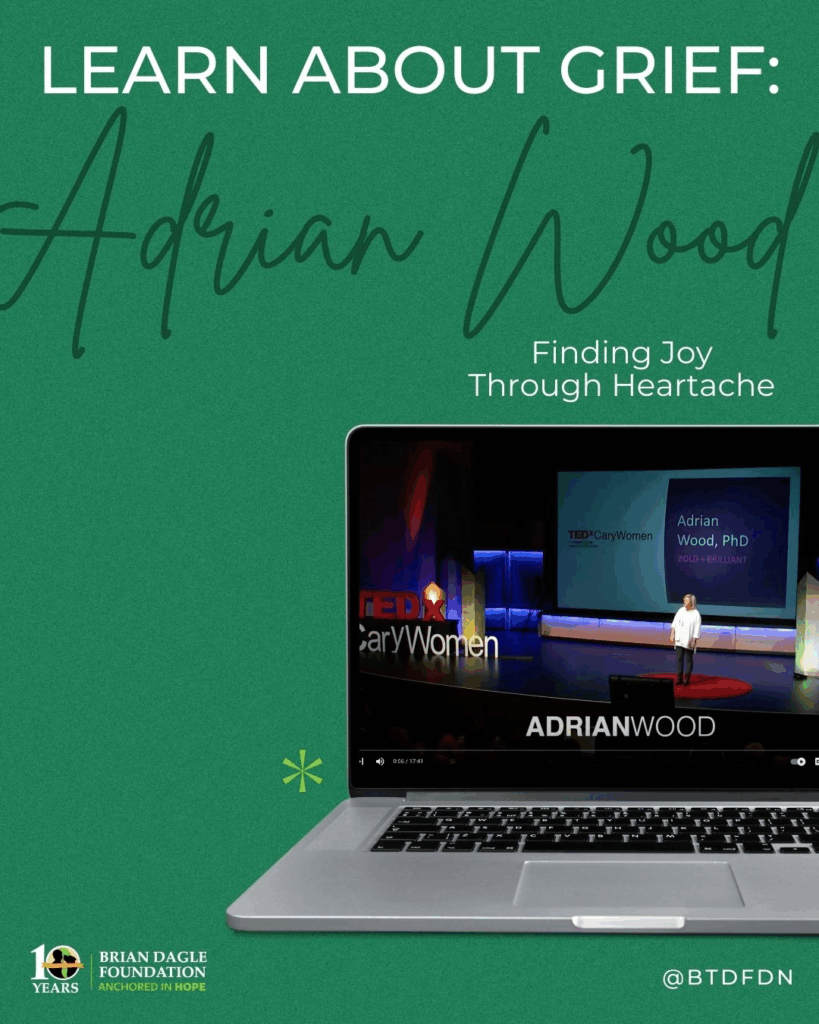

Video: Finding Joy Through Heartache
Video: Finding Joy in Grief
Book: When all that’s Left of Me is Love A Daughters story of Letting Go By Linda Campanella
Article: How to Find Joy in the Midst of Grief



“Remember that wherever your heart is, there you will find your treasure.” – Paulo Coelho
“Some of you say, “Joy is greater than sorrow,” and others say, “Nay, sorrow is the greater.”
But I say unto you, they are inseparable.
Together they come, and when one sits alone with you at your board, remember that the other is asleep upon your bed.” – Kahlil Gibran from poem “On Joy and Sorrow”
“It’s okay to smile, laugh and feel joy while grieving. Small joys honor your journey, not diminish it” Ann Boleche
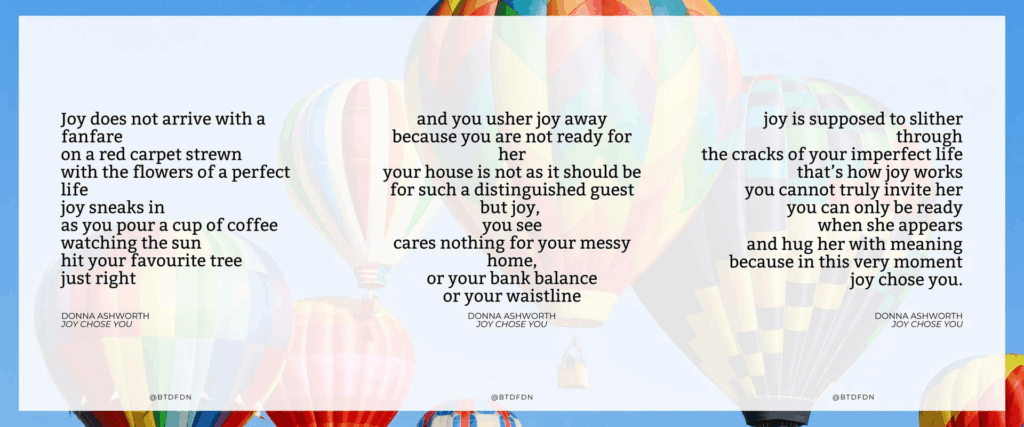
Poem: Joy Chose You, Pg 9, Donna Ashworth, Wild Hope

May’s gentle arrival brings Mental Health Awareness Month, inviting us to embrace the rich tapestry of our emotional experiences with compassion and understanding. This month reminds us that acknowledging our feelings—whether bright joy, deep grief, quiet anxiety, or resilient hope—is fundamental to nurturing our overall wellbeing.
For those navigating the winding path of grief, particularly those who carry the memory of a child in their hearts, this month offers meaningful validation that your mental health journey deserves attention and care.
The resources we highlight during Mental Health Month—mindfulness practices, professional support, and community connection—can serve as valuable companions as Mother’s Day approaches on the horizon. This holiday may awaken dormant emotions like spring rain stirring seeds long buried, and Mental Health Month encourages us to honor these feelings rather than hide them away.
Remember that true strength blossoms not in silence, but in honest expression and tender self-compassion. Whether you find solace in lighting a memorial candle, spending time in a place that holds special memories, writing heartfelt words, or sharing cherished stories of your child with trusted friends, Mental Health Month affirms that creating space for your unique emotional needs isn’t just acceptable—it’s an essential act of self-care and healing.
With love,
Ann & the Brian Dagle Foundation Family
Grief reminds us...
Grief is simply our love with no place to go.
Grief has no timeline.
We never get over our loss.
I use these words to try to comfort others who are grieving. I know all this is true. So why is it that on hard days like birthdays or death dates am I surprised at the rawness of my emotions?
The brain says, “It’s been 14 birthdays without Brian. You’re used to this by now.”
The heart says, “Brian would be 33 years old. He was only 19 when he left, this hurts so much.”
Why am I surprised that weeks before April 2nd, life is just harder to do.
The truth is, as the years move by, grief becomes more of a friend than an enemy. It’s like a humble friend gently reminding me that love never dies. It gently whispers to me that my son died. A validation to me that I have every right to feel all that I am feeling. And that despite the years, the tears flow as easily as if it were yesterday. This grief reminds me of the all too familiar feelings of overwhelming sadness, emptiness, and an ache that pervades every part of my being. I remind myself to lean into the sadness. Let the tears come.
I am also reminded that this heaviness of grief will soften. My breathing will become easier. Joy, happiness, and love will return in my heart. And I know that in time, the tears dry up and that in time, thoughts of Brian will bring smiles, not tears. And I am reminded of how fortunate I was to be his mom.
Happy 33rd birthday Brian. I love you and miss you everyday-
Love,
Mom

Grief often arrives unexpectedly, triggered by a song, a scent, or a memory that suddenly transports us back to our loss. During these moments, our bodies respond physically—perhaps with a tightening chest, a lump in the throat, or tears that seem to come from nowhere. Rather than immediately trying to “manage” these feelings away, there’s profound healing in allowing yourself to experience grief fully.
Next time you feel grief rising, try this:
- Pause and ask yourself, “Where do I feel the grief go in my body?”
- Notice without judgment where tension, heaviness, or pain manifests. This awareness is the first step toward genuine healing.
- Complement this practice with daily mindfulness for 10-15 minutes, creating a quiet space to acknowledge your feelings without being overwhelmed by them.
Remember, grief isn’t something to “get over”—it’s something to move through with compassion for yourself and the love that created your loss in the first place.
Books and Resources

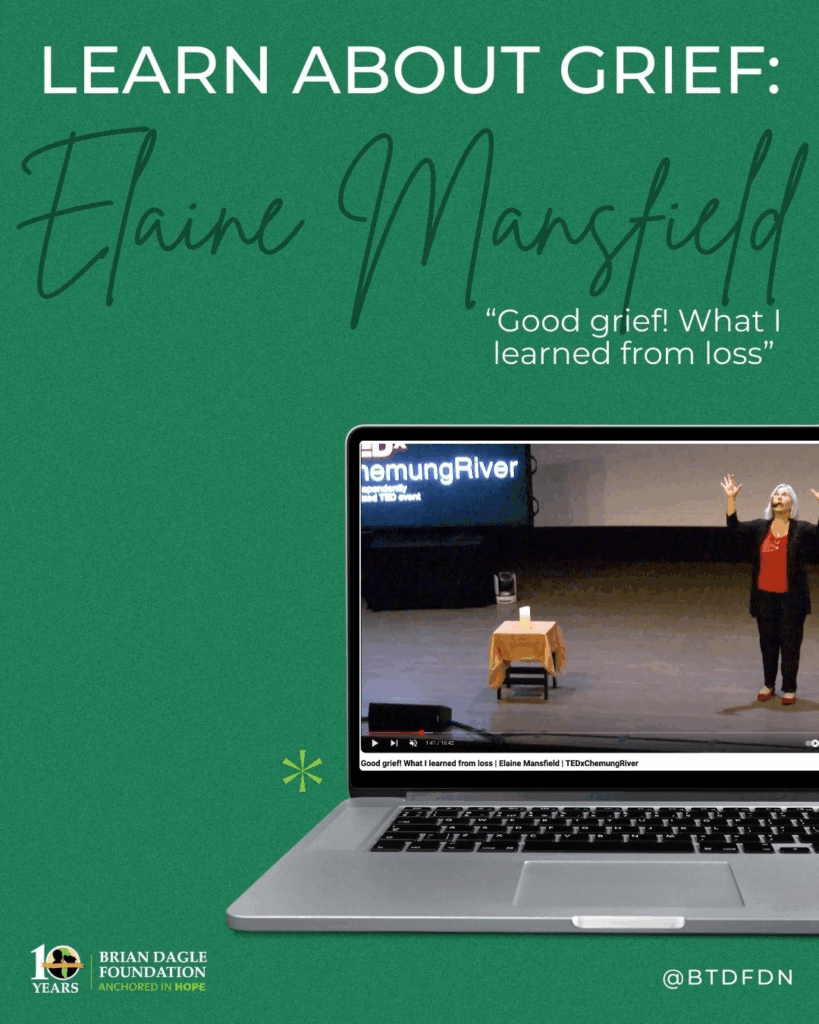
Video: “Good grief! What I Learned from Loss” by Elaine Mansfield
Book: “You’re Not Crazy: You’re Grieving” by Alan D. Wolfelt
Article: “Coping with Grief and Loss: Stages of Grief, the Grieving Process, and Learning to Heal” by Melinda Smith, M.A., Lawrence Robinson and Jeanne Segal, Ph.D.
Article: “After You’ve Experienced A Serious Loss – Using Rituals in Your Grief Journey” by Kelsey Collett, LCSW
Article: “Grief Rituals: Definition, Examples, & Ideas to Try” by Adam Koenig, MA, RP, CCC, CT
Article: “7 Grief Rituals That Get Us Through a Loss“
Inspiration

“When one person is missing the whole world seems empty.” Pat Schweibert
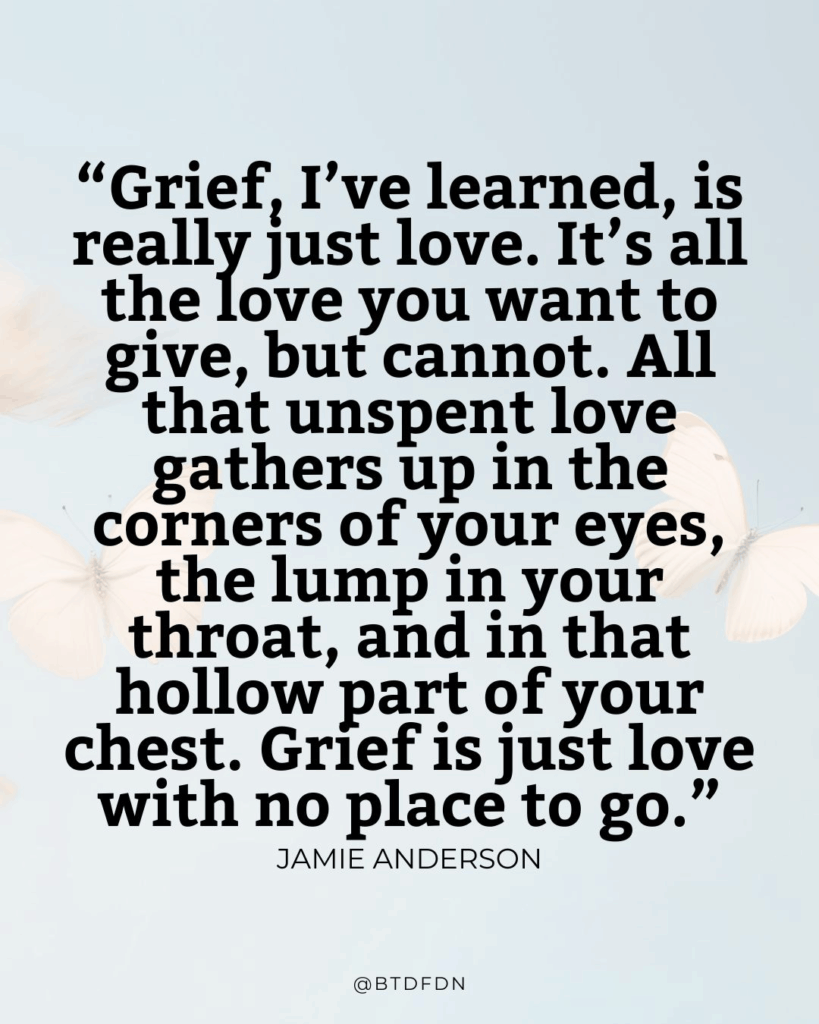
“Grief, I’ve learned, is really just love. It’s all the love you want to give, but cannot. All that unspent love gathers up in the corners of your eyes, the lump in your throat, and in that hollow part of your chest. Grief is just love with no place to go.” Jamie Anderson
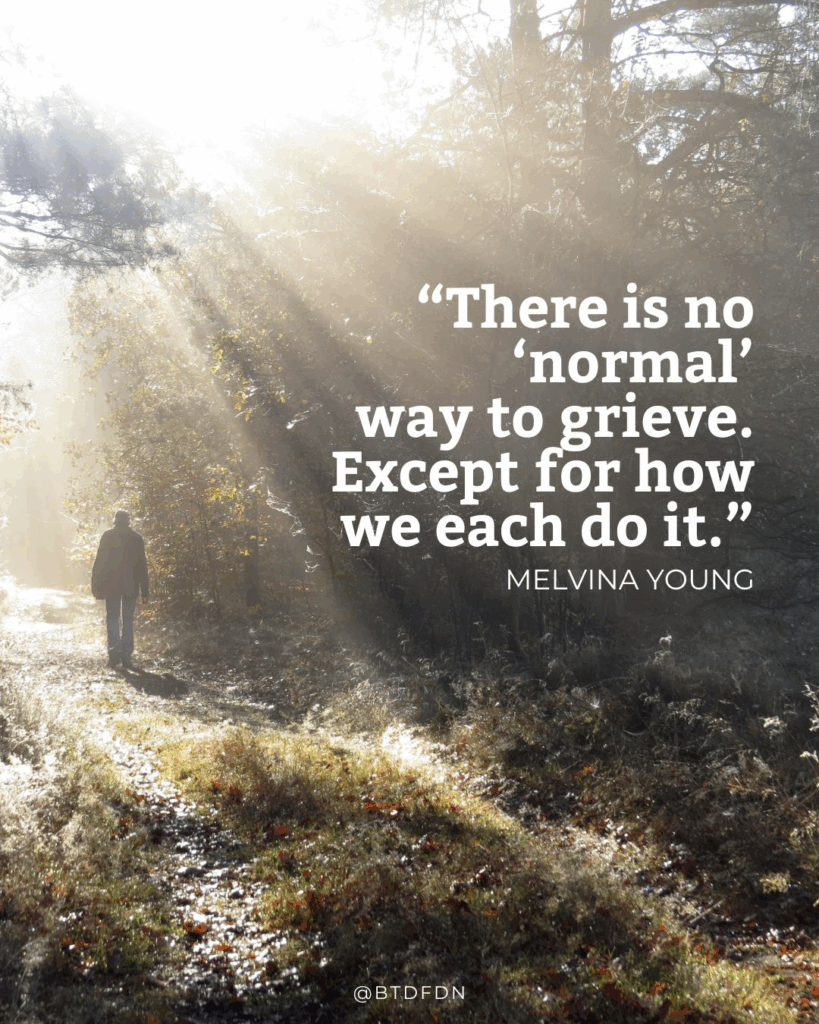
“There is no “normal” way to grieve. Except for how we each do it.” Melvina Young
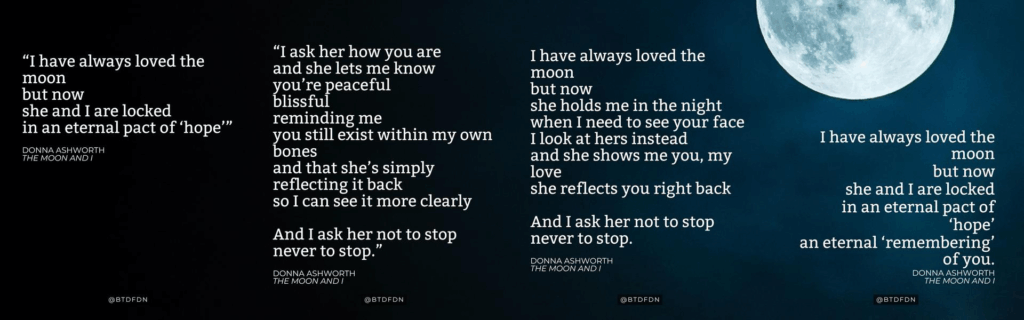
“The Moon and I” by Donna Ashworth, from Wild Hope